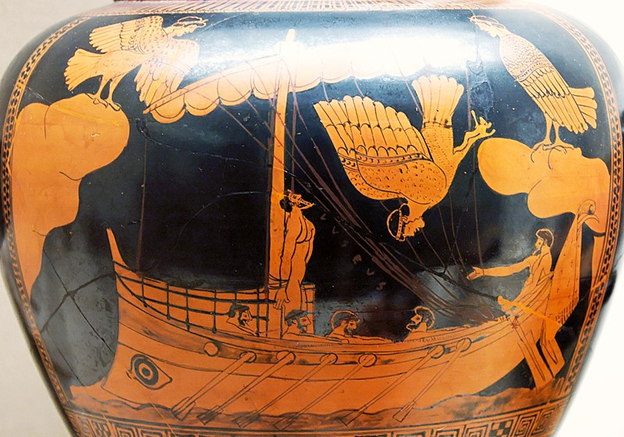
The world of Homer’s Odyssey is a fascinating montage of real and imagined landscapes. A veteran warrior’s 10-year journey to return home after a brutal decade-long siege of foreign peoples takes him through exotic encounters with ancient Trojans, Phoenicians and Sidonians, Ethiopians and Libyans, Egyptians and Cretans—places where archaeologists have found the remains of Bronze Age civilizations that thrived. But, Odysseus’s journey also takes him through mythical places, too, that seduce and delight our imaginations—the island of the divine witch Circe, the legendary nautical people of the Phaeacians, the giant-cannibal Laestrygonians, the cave of the Cyclops Polyphemus, and the Land of the Dead.
In this first-year seminar, you will become the hero of your own story, learning from the searching exploits of mortals and demi-gods who explored unknown lands and divine realms and who, like Odysseus’s son Telemachus, searched for meaning and fulfillment as they transitioned into adulthood. We will be reading Homer’s Odyssey (Emily Wilson’s celebrated translation) and a contemporary work of “fan-fiction” inspired by it (Madeline Miller’s Circe) as we reflect on how these stories provide archetypes for maturation, for leaving home to brave a dangerous and magical world, for taking on new responsibilities to family, friends, and community, and for navigating unfamiliar, multi-cultural landscapes.
The Odyssey encompasses universal human experiences that may resonate deeply with first-year students entering college. The epic, for example, touches on tensions between parents and their newly “adulting” offspring; differing world-views between older and younger generations; nostalgia for a far-away home; and embarking upon a “quest” as a form of education.
You will also learn how to find, read, and understand academic research articles in the Humanities generally, and particularly on Homer’s Odyssey. You will be given multiple opportunities to enhance your oral and written communications skills through writing and speaking assignments that privilege both literary analysis and deep, personal reflection. And, as your final project for this course, you will have the chance to write your own “fan-fiction” story involving an episode alluded to in the Odyssey, using Madeline Miller’s Circe and your own research as models. This course will be facilitated largely through discussion, with in-class and out-of-class assignments that are individual, collective, and interactive.