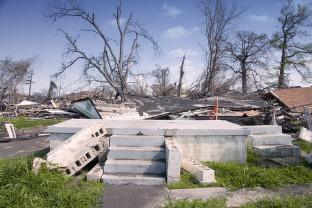
Throughout United States history, disasters have redefined the American physical and political landscape. The History of American Disasters is a first-year seminar focused on how disasters affect people’s lives and communities. There are two sections of this seminar:
- One that focuses on several historic disasters as a way to explore two major questions: what actually defines a disaster? And what do disasters tell us about United States history more broadly?
- The other section focuses on building fires in the United States during the late nineteenth and twentieth centuries: theater, school, workplace, nightclub, music venue, circus, prison, hospital.
In the aftermath of disasters, questions arise about the relationship between humans and our environment, how communities’ socioeconomic and racial/ethnic makeup influence policymaking, and how geography becomes part of the lived experience for Americans across the nation. Building fires in the United States during the late nineteenth and twentieth centuries (theater, school, workplace, nightclub, music venue, circus, prison, hospital) also illustrate how human-made decision-making and social structures can prove disastrous in their own right.
This seminar relies on readings, documentaries, class discussions and projects, presentations, and research and writing as students become familiar with a wide range of UMW resources, such as the Writing and Speaking Centers, Simpson Library, and Academic Advising. While not all disasters have been the subject of multiple scholarly studies, documentaries, primary sources, and online collections will help provide focused and broader study. Through the use of these tools in class and out of class, students will become familiar with college-level expectations while beginning to develop the skills necessary to do their best in future courses. In terms of building fires, students’ familiarity with locations—through the news if not through personal experience—will help them connect with the history of the United States as they study the factors that led to devastating fires in places where people expected to be safe. They will also discover what was learned from fires and what was done (and not done) to avoid future fires. Various fields and disciplines will be incorporated into the course, from economics to politics to religion to music to medicine and more. In terms of the seminar focused on major “natural” disasters, students will learn how to approach the events through various historical frameworks — including social, political, and environmental — and will choose their own disaster on which to focus for a culminating paper and project.